

scale(76.8)'/%3e%3cuse%20xlink:href='%23cn-a'%20width='30'%20height='20'%20transform='rotate(-121%20142.6%20-47)scale(25.5827)'/%3e%3cuse%20xlink:href='%23cn-a'%20width='30'%20height='20'%20transform='rotate(-98.1%20198%20-82)scale(25.6)'/%3e%3cuse%20xlink:href='%23cn-a'%20width='30'%20height='20'%20transform='rotate(-74%20272.4%20-114)scale(25.6137)'/%3e%3cuse%20xlink:href='%23cn-a'%20width='30'%20height='20'%20transform='matrix(16%20-19.968%2019.968%2016%20256%20230.4)'/%3e%3c/svg%3e)
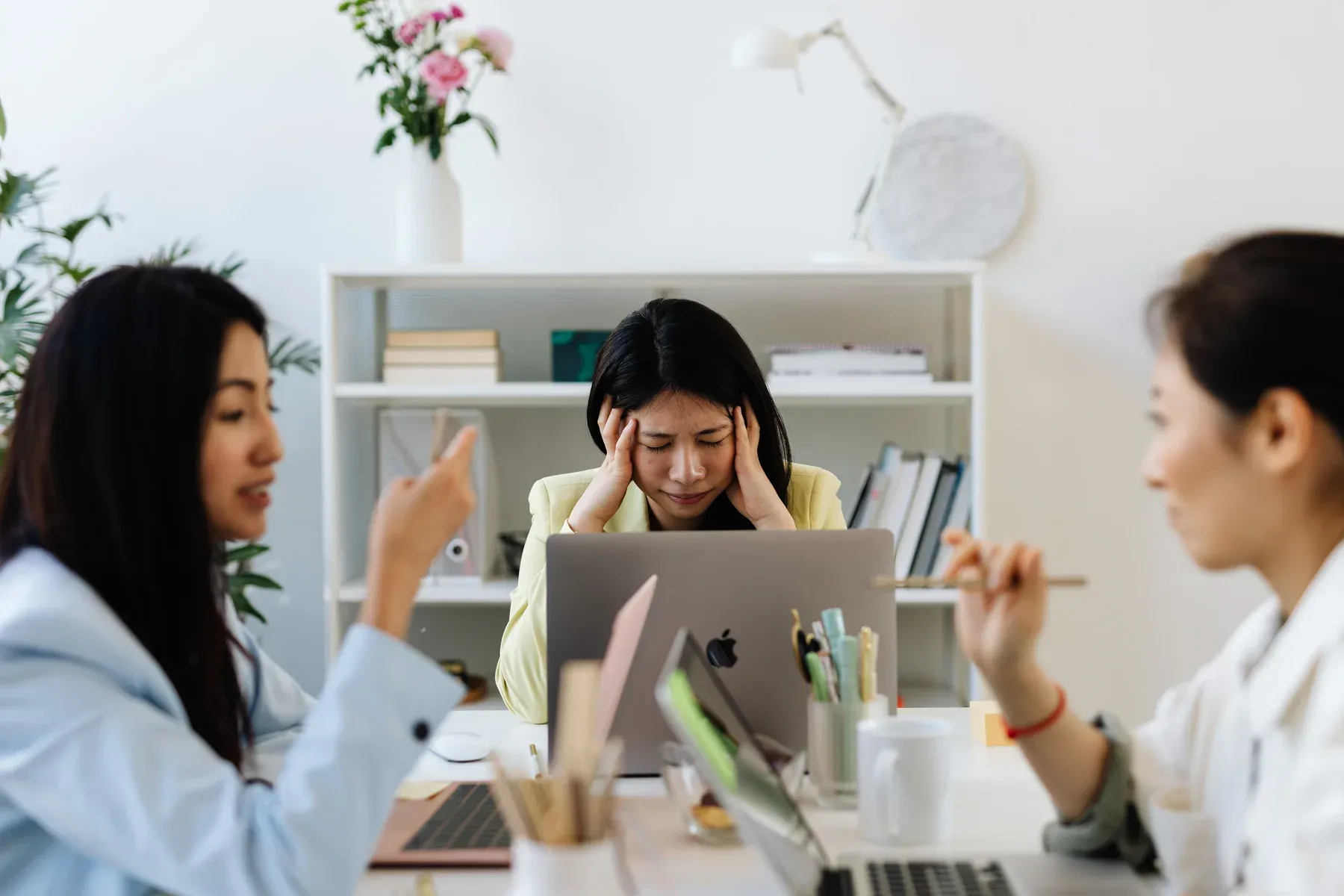
Yes, tension in the neck, upper back, and shoulders is one of the most frequent physical contributors to recurring headaches. When muscles at the base of the skull (suboccipital muscles) and shoulders (trapezius and levator scapulae) become tight, or when upper cervical spinal joints (C1–C3) lose normal mobility, they can refer pain directly into the head. This mechanism is known clinically as a cervicogenic headache and also frequently acts as a physical trigger for tension-type headaches.12
For office workers, commuters, and busy professionals across Chatswood and Sydney’s North Shore, hours spent leaning toward laptop screens or looking down at phones create prolonged mechanical strain that can turn everyday neck tightness into persistent head pain.
Safety first: While most neck-related headaches are musculoskeletal in nature, sudden explosive headaches (“thunderclap”), head pain accompanied by high fever with neck stiffness, confusion, vision loss, or stroke signs (facial droop, arm weakness, slurred speech) require immediate emergency care. Call triple zero (000) straight away if warning signs are present.3
How does the neck refer pain to the head?
Many people are surprised to learn that pain felt in the temples, forehead, or behind an eye can originate from joints and muscles in the neck. This referred pain occurs because of the way our nervous system is wired.
| Originating Structure | Neural Relay & Mechanism | Perceived Headache Location & Sensation |
|---|---|---|
| Upper Cervical Joints (C1–C3) | Sensory fibres from C1–C3 converge directly with the trigeminal nerve in the spinal cord nucleus. | Radiating ache from the upper neck spreading forward to the forehead and behind the eye. |
| Suboccipital Muscle Group (Base of Skull) | Chronic spasm compresses the greater and lesser occipital nerves traversing the muscle layers. | “Ram’s horn” pattern of burning ache from the skull base arching over the scalp to the brow. |
| Upper Trapezius & Levator Scapulae | Myofascial trigger points send sustained nociceptive input into the brainstem relay center. | “Question mark” pattern hooking up the side of the neck into the temples and jaw angle. |
| Sternocleidomastoid (SCM) | Anterior neck muscle tension refers signals across trigeminal sensory branches. | Deep ache across the forehead, eyebrow ridge, ear canal, sometimes with mild lightheadedness. |
1. The Trigeminocervical Complex (Shared Nerve Pathways)
In the upper spinal cord and brainstem lies a specialised sensory relay centre called the trigeminocervical nucleus. Sensory nerve fibres from the upper three cervical spinal nerves (C1, C2, and C3) converge directly with fibres from the trigeminal nerve—the primary sensory nerve responsible for feeling in your forehead, eyes, temples, and face.14
When joints or deep muscles in your upper neck are irritated or overloaded, pain signals travel into this shared relay station. The brain can misinterpret these incoming signals as coming from the forehead, temple, or behind the eye rather than the upper neck itself.
2. Suboccipital Muscle Spasm and Occipital Nerve Irritation
A group of small, high-density postural muscles sits directly beneath the base of your skull, called the suboccipital muscles. The greater and lesser occipital nerves pass directly through and around these muscles on their way up over the scalp.
When you sit in a “forward head posture” (craning toward a monitor), these suboccipital muscles contract continuously to stop your head from dropping forward. Over time, chronic tightness can compress or irritate these occipital nerves, sending a radiating, aching pain from the base of the skull up over the top of the head toward the brow—often described as a “ram’s horn” pattern of pain.25
3. Active Myofascial Trigger Points in the Shoulder and Neck
Hyperirritable knots within taut bands of muscle tissue—known as trigger points—frequently develop in the upper trapezius, levator scapulae, and sternocleidomastoid (SCM) muscles. When irritated by prolonged sitting, stress, or poor desk ergonomics, these trigger points reliably refer dull, aching pain into specific zones of the head:5
- Upper Trapezius: Refers pain up the side of the neck, hooking over the ear into the temple (“question mark” pattern).
- Levator Scapulae: Causes pain at the angle of the neck and base of the skull, severely restricting turning the head.
- Sternocleidomastoid (SCM): Refers pain deep into the forehead, behind the eye, or around the ear, sometimes accompanied by mild lightheadedness.
Is your headache coming from your neck? (Cervicogenic vs Tension vs Migraine)
Because head pain presents in different ways, distinguishing whether your neck is a primary driver or a secondary symptom is essential for choosing the right care path.
The table below outlines common clinical features to help you understand your symptoms:1246
| Feature | Cervicogenic Headache (Neck-origin) | Tension-Type Headache | Migraine Attack |
|---|---|---|---|
| Primary cause | Mechanical dysfunction in upper cervical joints (C1–C3) & deep neck muscles. | Muscle tension, central sensitization, emotional stress, lack of sleep. | Complex neurological disorder involving brain chemical & vascular changes. |
| Pain location | Usually one-sided (unilateral); starts at base of skull and spreads forward to temple/eye. | Usually both sides (bilateral); feels like a tight band or heavy vice around the head. | Often one-sided, but can affect both; throbbing, pulsating quality. |
| Neck movement connection | Pain is directly triggered or worsened by neck movement or sustained awkward neck postures. | Neck and shoulders often feel sore or tight, but neck movement rarely changes head pain instantly. | Neck stiffness can occur as an early symptom, but neck movement is not the root trigger. |
| Pain intensity | Moderate, non-throbbing, steady ache; can last hours to days. | Mild to moderate, non-throbbing, steady pressure; rarely disabling. | Moderate to severe, throbbing; significantly worsened by routine physical activity (walking/stairs). |
| Accompanying symptoms | Reduced neck range of motion, shoulder tightness, localised tenderness in upper neck. | General fatigue, mild light or sound sensitivity (rarely both), no nausea. | Nausea, vomiting, extreme sensitivity to light, sound and smells; possible visual aura. |
| Response to manual care | Highly responsive to targeted cervical joint mobilisation, chiropractic care, and exercise therapy.17 | Responds well to stress management, soft tissue work, ergonomic fixes, and hydration. | Requires medical diagnosis, acute/preventive medication, lifestyle tracking, and trigger avoidance.6 |
Our broader guide, Headaches, Migraines and Neck Tension: How to Decide What Care You Need, explains the comprehensive care pathways for overlapping headache conditions.
Why Chatswood professionals frequently suffer from neck-related headaches
In commercial hubs like Chatswood, our clinical team at Body Therapy Chiropractic regularly observes specific workplace and lifestyle habits that overload the cervical spine:

1. Forward Head Carriage (“Tech Neck” Loading)
The human head weighs approximately 5 kg in a neutral, balanced alignment. For every 2.5 cm (1 inch) your head cranes forward past your shoulders, the effective gravitational workload placed on your cervical spine and upper trapezius doubles:
- At 15° forward tilt: Your neck muscles support approximately 12 kg.
- At 30° forward tilt: Your neck muscles support approximately 18 kg.
- At 45° forward tilt: Your neck muscles support approximately 22 kg.
- At 60° forward tilt (looking down at a phone): Your neck muscles must hold 27 kg of continuous load!
This sustained isometric contraction starves neck muscles of fresh oxygenated blood, leading to localized lactic acid accumulation, muscle spasm, and referred head pain.25
2. Dual-Monitor and Laptop Setup Pitfalls
Many office workers in Chatswood work on dual screens where their primary monitor is placed off to one side, or they work directly off low laptop screens. Keeping your neck rotated by just 20–30 degrees for 7 to 8 hours a day creates asymmetrical joint compression at the C1–C2 atlantoaxial joint—the primary pivot of neck rotation—triggering one-sided cervicogenic headaches.
3. Stress Breathing and Elevated Shoulder Posture
Under work deadlines and cognitive stress, people unconsciously switch from diaphragmatic breathing to shallow “apical” chest breathing. This recruits the accessory breathing muscles—specifically the scalenes, upper trapezius, and levator scapulae—to lift the ribcage up to 20,000 times per day, creating severe chronic upper shoulder tightness and tension headaches.
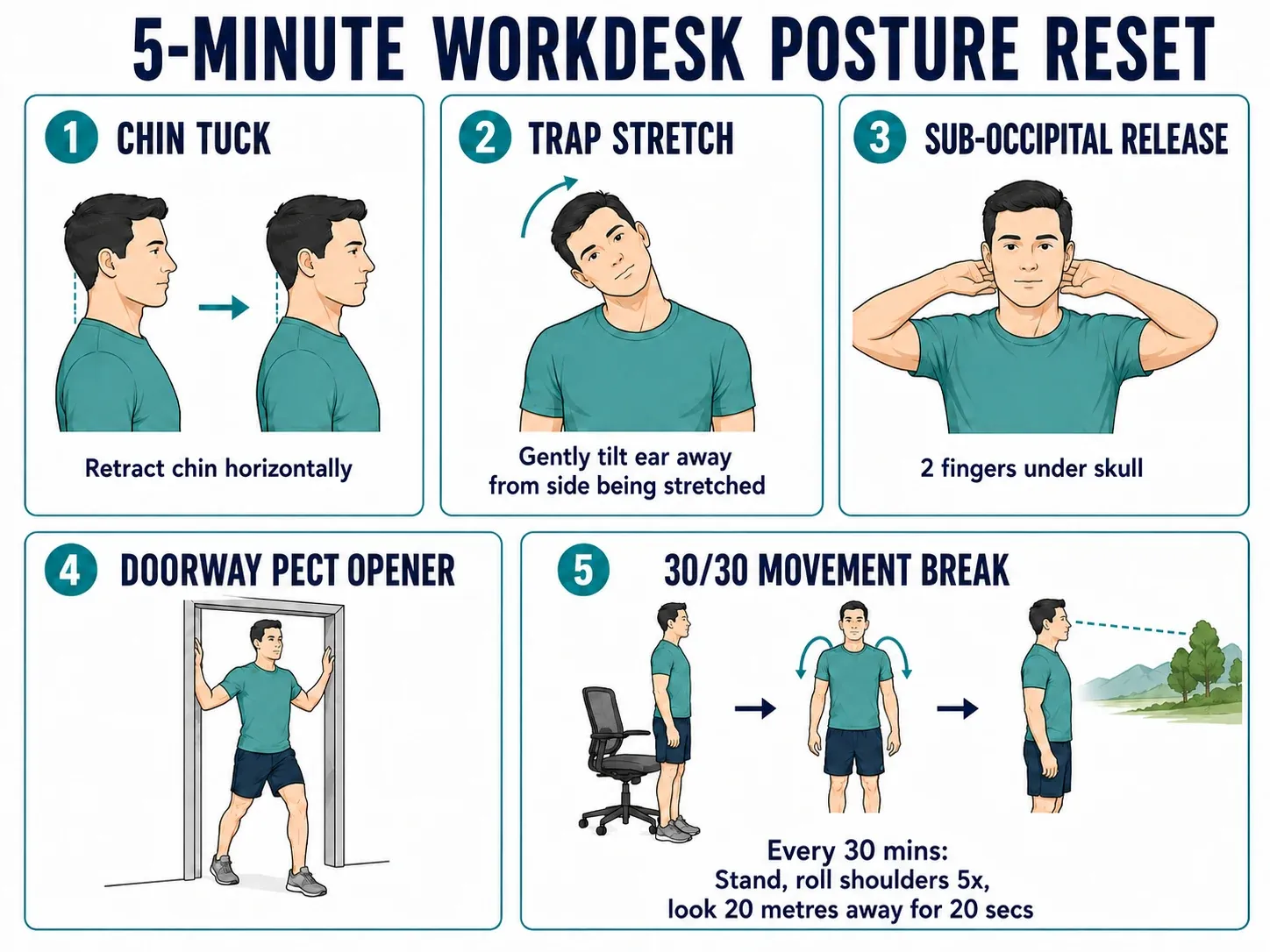
5 Practical exercises for immediate neck tension and headache relief
When you feel tension creeping from your shoulders into your temples during the workday, try these gentle, evidence-based exercises to reset your cervical posture and reduce muscle spasm:78
1. The Seated Chin Tuck (Deep Neck Flexor Activation)
- Why it helps: Realigns the cervical spine and relieves strain on overworked suboccipital muscles.
- How to do it: Sit tall in your chair with your shoulders relaxed. Look straight ahead. Place two fingers on your chin and gently guide your chin straight backwards (as if making a subtle “double chin”). Do not tilt your head down; keep your eyes level.
- Dose: Hold for 5 seconds. Repeat 10 times. Perform 2–3 sets throughout your workday.
2. Upper Trapezius and Levator Scapulae Gentle Stretch
- Why it helps: Releases muscle knots that refer pain over the ear and into the temple.
- How to do it: Sit on your right hand to anchor your right shoulder down. Gently bring your left ear toward your left shoulder until you feel a comfortable stretch along the right side of your neck. To target the levator scapulae, turn your head slightly and look down toward your left armpit.
- Dose: Hold gently for 20–30 seconds while breathing deeply. Repeat on the opposite side. Never pull aggressively.
3. Suboccipital Self-Myofascial Pressure Release
- Why it helps: Decompresses the greater occipital nerve at the skull base.
- How to do it: Place your thumbs or index and middle fingers at the base of your skull (just below the bony ridge at the back of your head). Press gently upward and inward until you locate the tender, tight muscular band. Lean your head back slightly into your fingers, apply steady, gentle pressure, and take 5 slow, deep breaths.
- Dose: 1–2 minutes of gentle sustained pressure.
4. Doorway Chest & Pectoral Stretch
- Why it helps: Opens tight chest muscles that pull shoulders forward into a slouched posture.
- How to do it: Stand in a doorway. Place your forearms vertically against the door frame with your elbows bent at 90 degrees. Step one foot forward gently until you feel an open stretch across the front of your chest and shoulders.
- Dose: Hold for 30 seconds. Repeat twice daily.
5. The 30/30 Movement Break Habit
- Why it helps: Prevents static postural fatigue and replenishes blood flow to spinal discs and muscles.
- How to do it: For every 30 minutes of continuous screen work, take 30 seconds to stand up, roll your shoulders backwards 5 times, extend your upper back, and look at an object 20 metres away to relax your eye muscles.
When to seek a professional assessment in Chatswood
While daily stretches and desk adjustments are valuable self-care habits, recurring or chronic neck-related headaches often indicate underlying mechanical joint restrictions or muscular imbalances that require clinical evaluation.
What happens during a chiropractic assessment at Body Therapy Chiropractic?
At our Chatswood clinic, our primary focus is identifying the exact musculoskeletal drivers of your symptoms:
- Detailed Clinical History: We listen to your symptom pattern, work habits, past injuries, stress factors, and headache frequency to understand your unique picture.
- Orthopaedic & Neurological Examination: We check cervical range of motion, test muscle strength and sensory reflexes, and rule out medical red flags.
- Cervical & Thoracic Joint Motion Palpation: We gently assess individual vertebrae (particularly C1, C2, and C3 at the upper neck and the upper thoracic spine) for joint restrictions or stiffness.
- Soft Tissue & Postural Analysis: We locate active trigger points in your neck and shoulder girdle and evaluate forward head posture, shoulder rounding, and ergonomic alignment.
- Tailored, Multi-Modal Care Plan: When care is appropriate, your personalised plan may include:
- Gentle spinal joint mobilisation or targeted chiropractic adjustments to restore normal cervical motion;
- Myofascial trigger point therapy and soft tissue release;
- Customised postural rehabilitation and neck-strengthening exercises;
- Workstation and ergonomic recommendations tailored to your specific setup.
Our practitioner team—including James Zheng (consulting in English and Mandarin) and Gianna Lau (consulting in English and Cantonese)—ensures clear, comfortable communication with no rushed consultations or aggressive treatment packages.
Learn more about what to expect on our What to Expect page, explore our service options on our Headaches, Neck Pain, Shoulder Pain, and Posture Correction pages, or check our straightforward Pricing & Health Funds details with on-the-spot HICAPS electronic claiming.
Frequently asked questions about neck tension and headaches
Can poor desk posture really give you a daily headache?
Yes. Prolonged forward head posture forces the small muscles at the base of the skull and upper shoulders into continuous contraction. This sustained tension irritates upper cervical nerves (C1–C3) and produces trigger points that refer dull, aching pain across the scalp, temples, and forehead on a daily basis.
How do I know if my headache is coming from my neck or is a true migraine?
Cervicogenic headaches are usually one-sided, start in the upper neck or back of the head, and are directly triggered or aggravated by specific neck movements or awkward postures. Migraines, by contrast, are neurological conditions characterized by throbbing pain, nausea, vomiting, and sensitivity to light and sound, and are not directly caused by moving the neck. However, both conditions can co-exist, which is why an individual clinical examination is recommended.16
Can sleeping on the wrong pillow cause morning neck headaches?
Yes. A pillow that is too high, too flat, or lacks proper cervical contouring forces your neck into awkward bending or twisting angles for 7 to 8 hours. This can compress the facet joints of the upper cervical spine (C1–C3) and cause waking with a stiff neck and a throbbing temple headache. Read our guide on Best Sleeping Positions for Neck and Lower-Back Comfort for ergonomic pillow advice.
Does cracking or popping my own neck help relieve tension headaches?
While self-manipulating (“cracking”) your neck may give temporary relief due to a brief release of endorphins, it usually only mobilises the hypermobile joints above or below the restricted segment. Without addressing the stiff, restricted joints and muscular trigger points, the tension and headaches quickly return. Gentle, targeted professional mobilisation is much safer and more effective.
How many sessions does it typically take to see improvement with neck tension headaches?
Response times vary based on how long the problem has existed, your daily screen demands, and overall lifestyle factors. Many patients notice improved neck mobility and a reduction in headache intensity within 3 to 6 targeted sessions, combined with daily desk adjustments and prescribed home exercises. Your practitioner will outline an individualized timeline during your initial assessment.
What this guide cannot determine
This guide provides general educational and ergonomic information and does not replace an in-person clinical assessment. It cannot diagnose specific headache disorders, rule out serious underlying secondary pathology, or guarantee individual outcomes from home exercises or manual therapy.
If your headache is sudden, unusually severe, accompanied by fever, neurological symptoms, or vision loss, seek urgent medical care immediately.
Take the first step toward lasting relief
You do not have to accept recurring neck stiffness and tension headaches as an unavoidable part of office life. By combining ergonomic workstation improvements, daily postural micro-breaks, and targeted clinical care, you can address the root mechanical causes of your discomfort.
- Explore the complete topic: Read our Comprehensive Guide to Headaches, Migraines and Neck Tension.
- Check your workstation setup: Review our Tech Neck & Screen Habits Desk Setup Checklist.
- Book an appointment in Chatswood: Visit Body Therapy Chiropractic online or call our friendly team to arrange an assessment at our clinic on Level 2, Suite 204, 6 Help Street, Chatswood NSW 2067.
References
Footnotes
-
Bogduk N, Govind S. Cervicogenic headache: an assessment of the evidence on clinical diagnosis, invasive tests, and treatment. The Lancet Neurology. 2009;8(10):959-968. ↩ ↩2 ↩3 ↩4 ↩5
-
Biondi DM. Cervicogenic headache: a review of diagnostic and treatment strategies. The Journal of the American Osteopathic Association. 2005;105(4 Suppl 2):16S-22S. ↩ ↩2 ↩3 ↩4
-
Healthdirect Australia. Headaches — Emergency warning signs and when to seek urgent medical care. Australian Department of Health and Aged Care. Accessed August 2026. ↩
-
International Headache Society (IHS). The International Classification of Headache Disorders, 3rd edition (ICHD-3): Cervicogenic headache & Tension-type headache. Cephalalgia. 2018;38(1):1-211. ↩ ↩2
-
Simons DG, Travell JG, Simons LS. Travell & Simons’ Myofascial Pain and Dysfunction: The Trigger Point Manual (Vol 1: Upper Half of Body). 2nd ed. Baltimore: Williams & Wilkins; 1999. ↩ ↩2 ↩3
-
Royal Australian College of General Practitioners (RACGP). Headache in adults: GP diagnostic approach. Australian Family Physician. Accessed August 2026. ↩ ↩2 ↩3
-
Jull G, Trott P, Potter H, et al. A randomized controlled trial of exercise and manipulative therapy for cervicogenic headache. Spine. 2002;27(17):1835-1843. ↩ ↩2
-
Safe Work Australia. Ergonomics and preventing musculoskeletal disorders at computer workstations. Australian Government. Accessed August 2026. ↩