

scale(76.8)'/%3e%3cuse%20xlink:href='%23cn-a'%20width='30'%20height='20'%20transform='rotate(-121%20142.6%20-47)scale(25.5827)'/%3e%3cuse%20xlink:href='%23cn-a'%20width='30'%20height='20'%20transform='rotate(-98.1%20198%20-82)scale(25.6)'/%3e%3cuse%20xlink:href='%23cn-a'%20width='30'%20height='20'%20transform='rotate(-74%20272.4%20-114)scale(25.6137)'/%3e%3cuse%20xlink:href='%23cn-a'%20width='30'%20height='20'%20transform='matrix(16%20-19.968%2019.968%2016%20256%20230.4)'/%3e%3c/svg%3e)
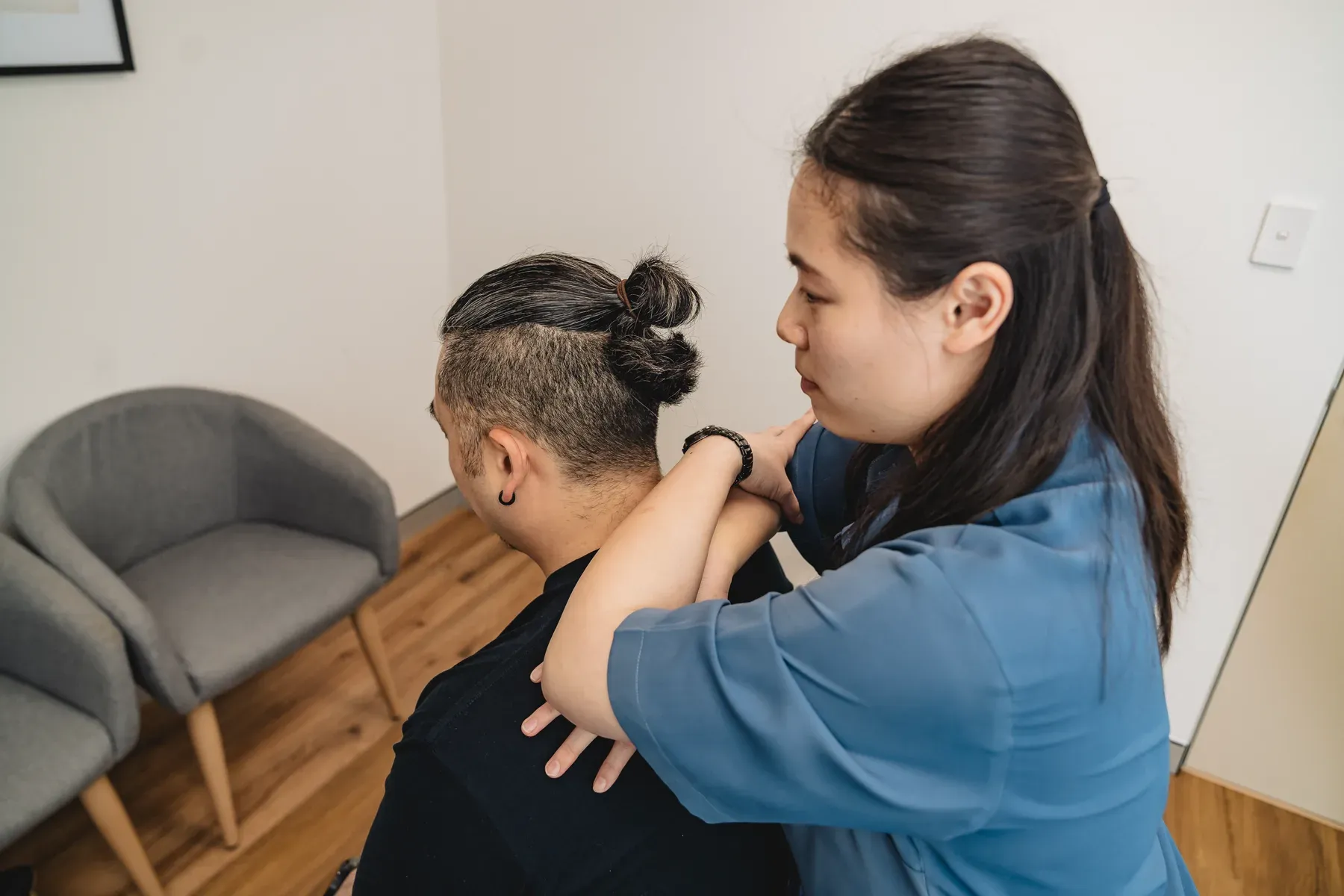
Headaches do not all have the same cause or care path. A pressing headache on both sides, a disabling migraine with nausea and light sensitivity, and a new sudden severe headache need different responses. Neck pain or stiffness can occur with more than one headache type, so it does not prove that the neck is the cause. Start with warning signs, then consider the pattern and its impact.
Safety first: Call triple zero (000) for a sudden severe headache or a headache with symptoms that concern you. Go immediately to an emergency department for a severe headache accompanied by fever, neck stiffness, confusion, behaviour or memory changes, vision changes, unexplained vomiting or a seizure.12
When a headache needs emergency or urgent medical care
Do not assume a severe or unfamiliar headache is “just a migraine”, even if you have experienced migraine before.
Call 000 if a headache is sudden and severe, or if you notice possible stroke signs. Use the F.A.S.T. check:
- Face: has one side of the face or mouth drooped?
- Arms: can the person lift both arms, or is one arm weak?
- Speech: is speech slurred, or is it difficult to speak or understand?
- Time: call 000 immediately if you see any of these signs.3
Other possible stroke signs include sudden weakness or numbness, dizziness or loss of balance, sudden vision loss or blurring, difficulty swallowing, or a severe abrupt headache. Call 000 even if the signs disappear after a few minutes.3
Seek immediate emergency care for a headache with:12
- fever or a stiff neck;
- confusion, altered behaviour, memory changes or reduced consciousness;
- blurred or double vision, or another sudden vision change;
- unexplained vomiting;
- loss of balance;
- a seizure; or
- severe pain beginning after a head injury.
Seek prompt medical advice for a new headache that is progressively worsening, starts with coughing or straining, gets worse when lying down, is different from your usual pattern, or begins suddenly during pregnancy.1 If symptoms are severe, rapidly changing or difficult to classify, call 000.
Common headache patterns to discuss with a clinician
The table below describes common patterns, not diagnostic rules. Symptoms overlap, and a clinician needs to consider your history and examination.4
| Pattern | Common features | Care path to consider |
|---|---|---|
| Tension-type headache | Usually mild to moderate pressure or tightness, often on both sides; may feel like a band; neck and shoulders may feel sore; routine movement usually does not make it worse. | Self-care may be reasonable for an occasional familiar episode without warning signs. See a GP if headaches become frequent, severe or limiting. |
| Migraine attack | Often moderate to severe and throbbing; may affect one side or both; can worsen with activity and include nausea, vomiting, or sensitivity to light, sound or smell. Some people have aura. | See a GP for diagnosis and an individual management plan, especially when attacks are new, frequent, changing or disabling. |
| Cluster headache pattern | Very severe one-sided pain, commonly around an eye, with same-side tearing, a blocked or runny nostril, eyelid changes or facial sweating; attacks can occur in repeated clusters. | Prompt medical assessment is important because cluster headache has a distinct treatment path and can resemble other conditions. |
| Headache with neck discomfort | Headache occurs with neck stiffness, soreness, restricted movement or upper-shoulder discomfort. This can occur in migraine and tension-type headache as well as other presentations. | Screen for warning signs first. An assessment may consider both neurological headache features and musculoskeletal contributors; neck discomfort alone does not establish the cause. |
The most useful distinction is not simply “headache versus migraine”. It is whether the symptoms are familiar or new, whether they match a recognised pattern, how much they affect function, and whether warning signs are present.
How migraine commonly differs from tension-type headache
Migraine is a neurological condition, not simply a very bad tension headache. A migraine attack often interferes with normal activity and may include nausea, vomiting and sensitivity to light or sound.5
Some people experience aura before or during an attack. Aura can involve reversible visual, sensory or speech changes, such as flashing lights, blind spots, zigzag lines, numbness or difficulty speaking. Not everyone with migraine has aura, and aura can sometimes occur without a later headache.5
Tension-type headache more often causes a steady, mild or moderate pressing sensation on both sides of the head. It may feel like a tight band, and the neck or shoulders can also feel sore. It usually does not worsen with normal movement.1
These are tendencies, not a home diagnostic test. Migraine can affect both sides, tension-type headache can include sensitivity to light or sound, and a person can experience more than one headache disorder.
What does neck tension tell you?
Neck discomfort is useful information, but it is not a diagnosis. Healthdirect lists neck pain or stiffness among symptoms that can occur during migraine, while tension-type headache may also involve a sore neck and shoulders.15
An assessment may ask:
- Did the neck discomfort begin before, during or after the headache?
- Does neck movement reproduce or change the familiar head pain?
- Is the headache linked with prolonged desk work, driving or another sustained task?
- Are nausea, vomiting, aura, or sensitivity to light and sound present?
- Does activity make the headache worse?
- Is this a familiar pattern, or has it changed?
- Are there neurological or systemic warning signs?
This wider history helps avoid two mistakes: assuming every headache with neck tension comes from the neck, and ignoring neck or shoulder factors that may still be relevant to comfort and management.
Which care path should you choose?
After checking the emergency guidance above, use this sequence.
1. Emergency care
Call 000 or go to an emergency department for sudden severe headache, possible stroke signs, seizure, confusion, significant vision changes, fever with neck stiffness, unexplained vomiting or other serious warning signs.
2. GP assessment
Arrange a GP appointment when headaches are new, recurrent, changing, frequent, severe or interfering with work, sleep and normal activities. A GP can assess the headache pattern, consider other medical causes, review medicines and decide whether tests or referral to a neurologist or another professional are appropriate.
Healthdirect advises seeing a doctor when headaches are more frequent or severe than usual, prevent normal activity, or lead to pain-relief medicine use more than twice a week.12
3. Pharmacist advice
A pharmacist can help determine whether an over-the-counter medicine is suitable with your health conditions and other medicines. Follow the label and avoid repeatedly increasing or combining medicines without advice. Frequent use of acute headache medicine can itself contribute to medication-overuse headache.12
4. Musculoskeletal assessment
Once emergency and other medical causes have been considered, a musculoskeletal assessment may be relevant when a familiar headache pattern occurs alongside neck or shoulder discomfort, restricted movement or sustained work demands. The purpose is to determine what factors may be modifiable and whether this form of care is suitable—not to claim that every migraine or headache begins in the spine.
Our headaches, migraines and neck pain pages outline the concerns assessed at Body Therapy Chiropractic in Chatswood. The what to expect page explains the consultation process, including referral elsewhere when another care path is more appropriate.
Keep a useful headache diary
A diary cannot diagnose a headache, but it can give your GP or other practitioner a clearer pattern than memory alone. Record each episode consistently.
| What to record | Useful detail |
|---|---|
| Start and finish | Date, time, speed of onset and duration |
| Pain pattern | Location, pressure or throbbing, severity from 0–10 |
| Other symptoms | Nausea, vomiting, light or sound sensitivity, aura, neck discomfort, dizziness or neurological changes |
| Possible context | Sleep, meals, hydration, menstrual cycle, stress, screen work, exercise, illness or injury |
| Effect on activity | Whether you could work, drive, exercise, eat or sleep normally |
| Medicines | Name, dose, time taken and whether it helped; include all headache-treatment days |
| What was different | A new symptom, changed location, faster onset or greater severity than usual |
Bring the diary and a current medicines list to appointments. Do not delay urgent care in order to complete it.
Questions to ask at an assessment
- Which headache pattern best fits my history, and what does not fit?
- Are there features that require medical investigation or referral?
- Could any medicine use be contributing to headache frequency?
- What should I do at the start of the next familiar attack?
- Which symptoms mean I should seek urgent care?
- If neck or shoulder factors are relevant, what can reasonably be assessed or changed?
- When should the plan be reviewed if it is not helping?
A good care plan should state its limits. No practitioner should guarantee that one treatment will cure migraine, prevent every headache or remove the need for appropriate medical care.
Common questions about headaches, migraine and neck tension
Can neck tension trigger a headache?
Neck and shoulder discomfort may occur with tension-type headache and may be relevant in some musculoskeletal headache presentations. Neck pain and stiffness also commonly occur during migraine, so their presence does not prove that neck tension triggered the attack. The timing and complete symptom pattern need assessment.
Does an aura always mean migraine?
Aura is associated with migraine and can include fully reversible visual, sensory or speech symptoms. New neurological symptoms can also resemble stroke or another urgent condition. If the symptoms are new, unusual, sudden, prolonged or include weakness, seek urgent medical advice rather than diagnosing an aura yourself.
When should frequent headaches be discussed with a GP?
See a GP when headaches are becoming more frequent or severe, differ from your usual pattern, interrupt normal activities, or require pain-relief medicines more than twice a week.12 A GP can help establish the diagnosis and discuss acute and preventive options.
Do I need a scan for recurring headaches?
Not everyone with recurring headaches needs imaging. The decision depends on the history, examination and presence of warning signs. A GP or emergency clinician can determine whether imaging or specialist referral is warranted; a scan should not replace a clinical assessment.
Can chiropractic care treat migraine?
Migraine is a neurological condition requiring an appropriate diagnosis and management plan. A chiropractor may assess musculoskeletal factors when neck or shoulder concerns coexist, but should not imply that spinal care treats every cause of headache or replaces medical migraine management. Suitability depends on the individual findings and referral should occur when needed.
What this article cannot determine
This guide cannot diagnose your headache, distinguish migraine aura from stroke, rule out a serious secondary cause, prescribe medicine or determine whether chiropractic care is suitable. Headache patterns can change, and warning-sign lists cannot cover every presentation. Seek urgent medical help when symptoms are sudden, severe, rapidly worsening or concerning.
Decide by safety, pattern and impact
First check for emergency warning signs. Next consider whether the headache resembles a familiar tension-type or migraine pattern, and how much it affects normal activity. Then choose the professional who can answer the next question: emergency clinicians for urgent risk, a GP for diagnosis and medical management, a pharmacist for medicine safety, and a musculoskeletal practitioner only when that assessment is appropriate.
Explore this topic
Supporting articles in this series are scheduled through September:
- Migraines vs Headaches: Key Differences, Common Triggers and When to Seek Help — 14 September 2026.
- Headache Warning Signs: When to Seek Urgent Medical Care — 21 September 2026.
- Can Neck and Shoulder Tension Contribute to Headaches? — 28 September 2026.
References
Footnotes
-
Healthdirect Australia. Tension headache. Accessed 12 August 2026. ↩ ↩2 ↩3 ↩4 ↩5 ↩6 ↩7 ↩8
-
Healthdirect Australia. Medicines for headaches. Accessed 12 August 2026. ↩ ↩2 ↩3 ↩4 ↩5
-
Stroke Foundation Australia. Signs of stroke. Accessed 12 August 2026. ↩ ↩2
-
NSW Agency for Clinical Innovation, Emergency Care Institute. Headache clinical tool. Minor revision May 2026; accessed 12 August 2026. ↩
-
Healthdirect Australia. Migraine. Accessed 12 August 2026. ↩ ↩2 ↩3