

scale(76.8)'/%3e%3cuse%20xlink:href='%23cn-a'%20width='30'%20height='20'%20transform='rotate(-121%20142.6%20-47)scale(25.5827)'/%3e%3cuse%20xlink:href='%23cn-a'%20width='30'%20height='20'%20transform='rotate(-98.1%20198%20-82)scale(25.6)'/%3e%3cuse%20xlink:href='%23cn-a'%20width='30'%20height='20'%20transform='rotate(-74%20272.4%20-114)scale(25.6137)'/%3e%3cuse%20xlink:href='%23cn-a'%20width='30'%20height='20'%20transform='matrix(16%20-19.968%2019.968%2016%20256%20230.4)'/%3e%3c/svg%3e)
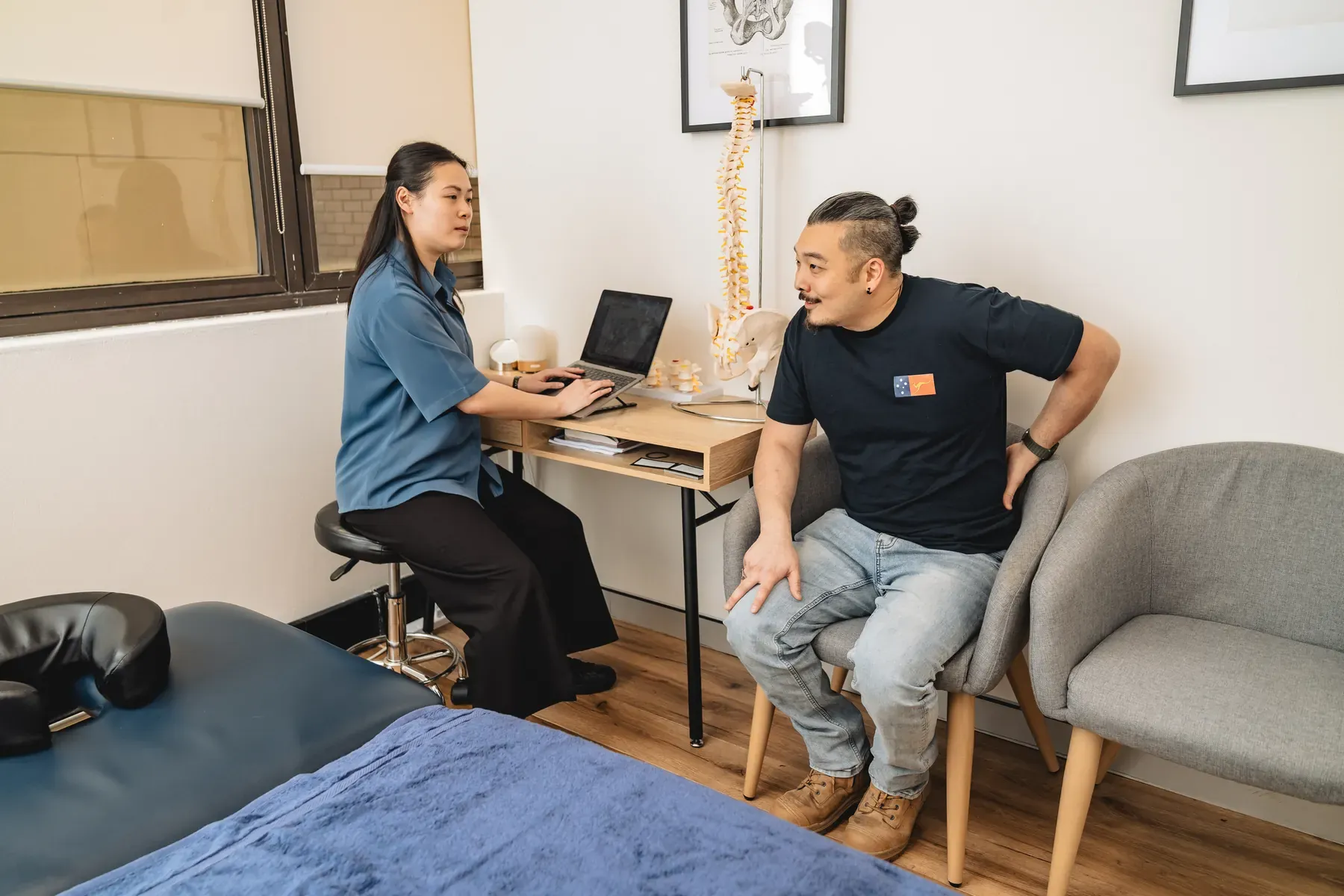
Recurring hip or knee discomfort during running is worth assessing when it changes how you run, keeps returning or affects everyday activities. Pain around the outside of the knee can occur with iliotibial-band problems, but the location alone does not establish a diagnosis.1 An assessment considers the pattern, training history and movement, and whether medical review is needed before planning a return to running.
For runners around Chatswood and the Lower North Shore, the practical question is often: should I change my training, or get this checked first? Start with the safety points below, then prepare a clear account of what you have noticed.
When medical assessment comes first
Seek medical care promptly for sudden or intense hip pain, pain following a fall, inability to move the hip or bear weight, or fever with hip pain.2
Go to an emergency department for a badly swollen or misshapen knee, a hot red knee with fever, or knee pain after a major injury. A knee that locks, gives way or cannot bear weight also needs medical review.3 Call 000 for a medical emergency.
These warning signs are not exhaustive. Do not use a routine chiropractic booking or an online running guide to delay care for a serious injury.
Why the painful spot is only part of the picture
The iliotibial band, often shortened to IT band, is a band of connective tissue along the outside of the thigh between the hip and knee. IT-band syndrome is an overuse problem seen in runners and other athletes.1
However, “outside-knee pain” and “IT-band syndrome” are not interchangeable labels. Knee pain has several possible causes, including injuries and medical conditions.3 Hip pain can also be referred from another area, including the lower back.2
Use the location to describe the concern, rather than deciding which tissue needs treatment. “It starts outside my right knee after running, and stairs are now uncomfortable” gives a clinician useful information without assuming a diagnosis.
What changed before the discomfort began?
AAOS identifies sudden training increases, inadequate recovery and uneven or banked running surfaces among factors associated with IT-band syndrome.1 These are points to discuss, not proof of the cause in an individual runner.
Compare the weeks before the discomfort started with your usual routine:
- Did distance, pace, hills or session frequency change?
- Did you restart after time off?
- Did footwear or running surfaces change?
- Did gym sessions, work demands or other activities increase too?
- Was there a sudden twist, fall or impact?
Do not change several things at once simply because each is a possible factor. Ask which changes matter in your case and how to evaluate them.
What to record before your appointment
A short training diary can make the conversation more specific. Note where the discomfort starts, when it appears, what happens after stopping and how it affects walking, stairs or sleep. Include any swelling, locking, giving way or new symptoms.
Bring your recent distances and sessions, relevant reports, and a clear goal: returning to comfortable recreational runs may require a different discussion from preparing for an event.
Useful questions include:
- What possibilities are we considering? Ask whether the findings point to a local problem or whether another area needs assessment.
- Do I need medical review or imaging? Ask what further investigation would clarify and whether it would change management.
- What can I do while this is being assessed? Discuss running, walking and other activities separately.
- What would count as progress? Agree on practical milestones and a review point.
These are discussion prompts, not a diagnostic checklist.
Changing training without guessing at a treatment
Do not repeatedly test the same painful run to see whether the problem has disappeared. Ask which activities need temporary modification and whether an alternative is appropriate for you.
For a diagnosed IT-band problem, management commonly includes activity modification, physiotherapy and a gradual return.1 That does not mean every runner needs the same stretches, strengthening routine, massage or footwear change.
Ask for a plan that explains what to start with, when to increase activity and what changes should prompt reassessment. This article does not recommend a universal weekly distance increase, pain threshold or return date.
Where a chiropractic assessment may fit
Our hip pain and muscle strains and sprains pages describe related musculoskeletal concerns. At our Chatswood clinic, an assessment can consider whether chiropractic care may be suitable for your circumstances or whether a GP, physiotherapist or other clinician should be involved.
Read Sports Injuries: Assessment, Recovery and Returning to Activity in Chatswood for the broader context. Our what to expect page explains the appointment process. Once urgent concerns have been addressed, you can book an assessment to discuss your running goals and next steps.
Common questions
Is pain outside my knee always an IT-band problem?
No. The location is useful information, but a diagnosis needs assessment. Describe the pattern and any associated symptoms rather than choosing a label yourself.
Should I stretch or foam-roll the sore area?
Ask whether either is appropriate once the cause has been assessed. A generic routine is not a substitute for deciding what is causing the discomfort and what management is suitable.
Can I keep running if the pain settles afterwards?
Settling after a run is worth recording, but it does not by itself establish that continuing is appropriate. Discuss the recurring pattern and its effect on your function.
Will changing shoes solve it?
Footwear is one possible part of the training history, not a guaranteed solution. Discuss what changed before buying equipment or making several adjustments at once.
What this guide cannot tell you
This guide cannot diagnose IT-band syndrome, exclude a significant hip or knee injury, prescribe exercises or clear you to race. Persistent or worsening discomfort needs review, and emergency warning signs take priority over routine training advice.