

scale(76.8)'/%3e%3cuse%20xlink:href='%23cn-a'%20width='30'%20height='20'%20transform='rotate(-121%20142.6%20-47)scale(25.5827)'/%3e%3cuse%20xlink:href='%23cn-a'%20width='30'%20height='20'%20transform='rotate(-98.1%20198%20-82)scale(25.6)'/%3e%3cuse%20xlink:href='%23cn-a'%20width='30'%20height='20'%20transform='rotate(-74%20272.4%20-114)scale(25.6137)'/%3e%3cuse%20xlink:href='%23cn-a'%20width='30'%20height='20'%20transform='matrix(16%20-19.968%2019.968%2016%20256%20230.4)'/%3e%3c/svg%3e)
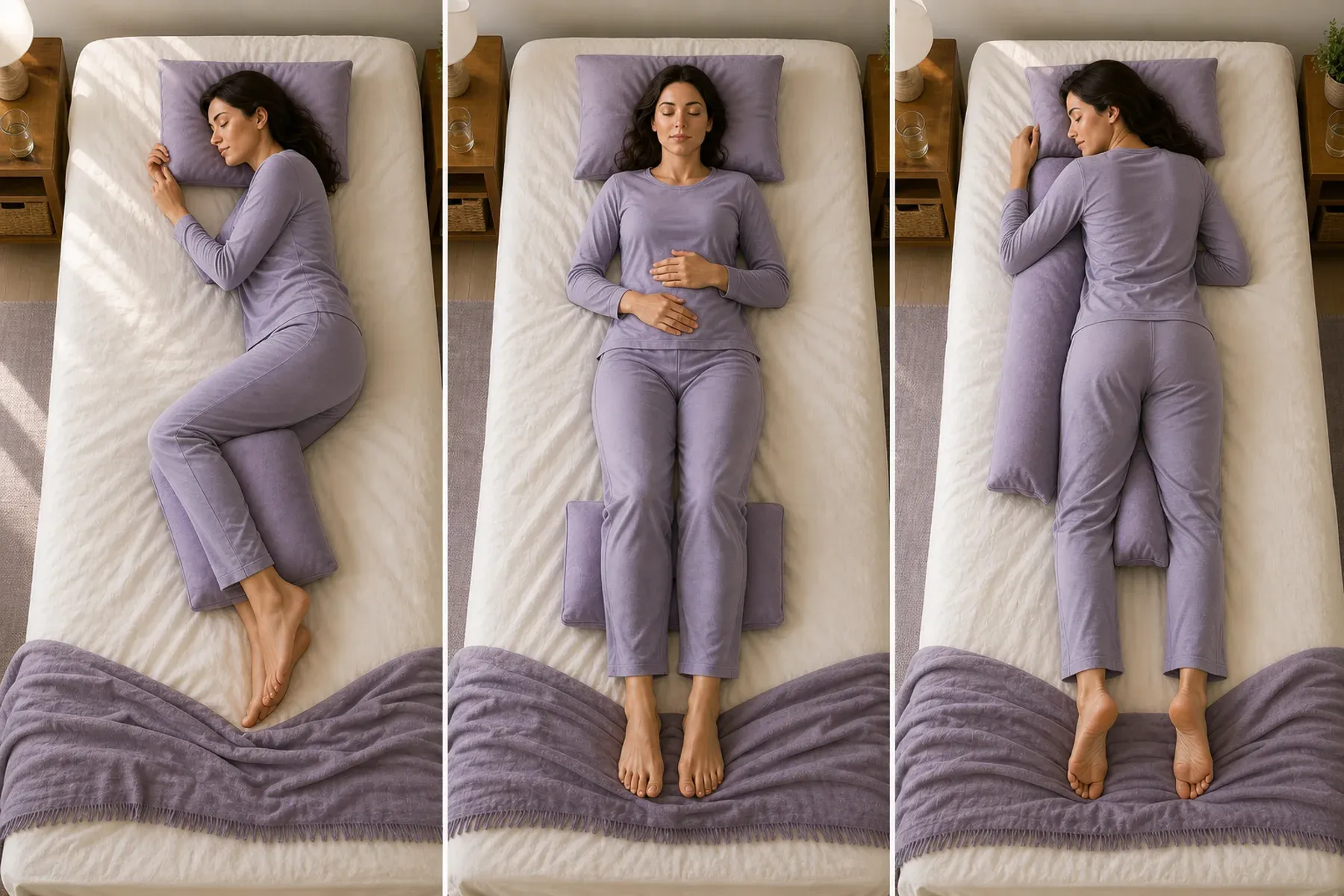
There is no single “best” sleeping position for every neck or lower back. Side sleeping and back sleeping are reasonable starting points because pillows can support the head, legs and trunk without forcing the body into one rigid posture. The useful test is simple: can you settle comfortably, sleep without repeatedly waking from pain, and get up without feeling consistently worse?
The short answer: start with comfort, support and room to move
Sleep position is only one part of the picture. Your pillow, mattress, recent activity, an injury, stress, sleep quality and an existing health condition may all affect how you feel in the morning. Research suggests that sleep posture can influence waking neck or back symptoms, but the evidence is still too limited to name one position that works for everyone.1
Instead of chasing a supposedly perfect posture, use three principles:
- Keep your head comfortably supported. Your pillow should fill the space between your head and the mattress without noticeably pushing your chin towards your chest or tipping your head back.
- Reduce unsupported twisting. If one part of your body rolls much further than another, an extra pillow may make the position feel more settled.
- Let yourself move. Changing position during the night is normal. You do not need to hold a precise pose until morning.
This article supports our complete guide to back, neck and posture concerns in Chatswood. It provides general comfort ideas rather than a diagnosis or an individual treatment plan.
Side sleeping: support the space between your shoulder and head
Side sleeping is a practical first option for many people with waking neck or lower-back discomfort. The aim is not to make the spine perfectly straight. It is to avoid a pillow setup that leaves your head hanging towards the mattress or propped noticeably away from it.
Try this side-sleeping setup
- Choose the head pillow by height, not by its marketing label. A broader shoulder or a firmer mattress may create a larger gap beneath the head; a softer mattress may allow the shoulder to sink further and reduce that gap.
- Keep both knees comfortably bent. Avoid pulling them tightly towards your chest unless that is genuinely comfortable for you.
- Try a pillow between the knees or thighs. It may reduce the feeling that the top leg is pulling the pelvis forwards. Remove it if it increases hip, knee or back discomfort.
- Support the upper arm if needed. Hugging a pillow can stop the upper shoulder and chest from rolling too far forwards.
- Do not sleep directly on a painful shoulder or hip. Change sides or try back sleeping if pressure on that area is the main problem.
If a pillow between the legs helps, it only needs to be thick enough to feel supportive. More height is not automatically better.
Back sleeping: support the head without forcing the neck
Back sleeping can feel comfortable when the head pillow supports the natural space behind the neck without lifting the head too far. Some people also find that a pillow under the knees makes the lower back feel more relaxed, while others do not.
Try this back-sleeping setup
- Check your chin position. If your chin is pushed strongly towards your chest, the head pillow may be too high. If your head tips back or your neck feels unsupported, it may be too low.
- Place a pillow under the knees as an optional comfort test. Start with a low pillow or folded towel. Keep it only if your lower back, hips and knees all feel comfortable.
- Keep both arms where the shoulders can relax. If placing an arm overhead causes tingling, numbness or shoulder discomfort, bring it back down.
- Use support, not force. You do not need to press your lower back flat against the mattress.
The idea that everyone with back pain needs an extra-firm mattress is not supported by the available research. One trial involving people with chronic non-specific low-back pain found better outcomes with medium-firm rather than firm mattresses, but that does not identify the right mattress for every person.2
Front sleeping: modify it if your neck or back feels worse
Front sleeping usually requires the head to stay turned to one side. Some people also notice more pressure through the lower back in this position. That does not mean front sleeping is universally harmful, but it is worth testing a different setup if you regularly wake with neck stiffness, headaches or lower-back discomfort.
If front sleeping is the only way you can settle, try one change at a time:
- use a thinner head pillow, if comfortable, so the neck is not pushed as far backwards;
- place a thin pillow under the hips or lower abdomen and keep it only if it reduces strain;
- use a body pillow to move gradually towards a supported three-quarter or side-lying position; or
- alternate the direction your head faces rather than always turning to the same side.
Do not force a new position through pain or sacrifice sleep simply to follow a posture rule. People with sleep apnoea, reflux, pregnancy-related needs, a recent operation or an injury may have position advice specific to their situation. Follow the guidance of the health professional managing that condition.
A practical pillow and mattress checklist
Products marketed for “orthopaedic” or “posture” support are not automatically right for your body. Pillow height and shape may matter, but studies have not identified one design that guarantees better sleep or less pain for everyone.3
Before buying anything, work through this checklist:
- Where do you feel unsupported? Neck, shoulder, waist, pelvis or knees?
- Does your pillow still recover its shape? A pillow that has flattened or formed a permanent hollow may no longer provide consistent support.
- Does the mattress visibly sag? Check the surface and base before assuming your sleeping position is the only issue.
- Can you trial a small adjustment first? Test a folded towel or a pillow you already own before purchasing a specialised product.
- Can the new product be returned? Comfort cannot be judged reliably from a few minutes in a shop.
- Did the change improve sleep as well as morning comfort? A setup is not useful if it feels aligned but keeps you awake.
Change one variable at a time. Replacing the mattress, pillow and sleeping position on the same night makes it difficult to tell what helped.
Use a seven-night comfort experiment
Your usual position and symptoms can vary from night to night, so judge a setup over several nights rather than one morning.
For seven nights, make one small adjustment and record:
| What to note each morning | Simple measure |
|---|---|
| Main sleeping setup | Side, back, front or mixed; note extra pillows |
| Neck comfort on waking | 0–10, where 0 is no discomfort and 10 is the worst you can imagine |
| Lower-back comfort on waking | 0–10 |
| Sleep disruption | Number of times pain or discomfort woke you, if known |
| Morning movement | Better, unchanged or worse than usual |
Keep normal daily activity in mind too. A long drive, unfamiliar exercise or an unusually stressful day may explain a change better than the pillow setup.
Stop the experiment if a position produces new pain, numbness, pins and needles, weakness, dizziness or severe headache. If symptoms continue, an individual assessment is more useful than repeatedly changing bedding.
When sleep-related pain needs medical advice
Morning stiffness that settles as you move is different from severe pain that wakes you repeatedly or comes with other symptoms. Healthdirect advises seeing a doctor when back pain is affecting sleep or daily activities, or is not improving after about six weeks.4 Seek advice sooner if symptoms are worsening or you are concerned.
Call 000 or go to the nearest emergency department if back pain:
- starts suddenly and is severe;
- follows a significant injury or accident;
- occurs with fever or feeling very unwell;
- prevents you from walking or moving;
- occurs with new weakness or numbness in the legs;
- occurs with loss of bladder or bowel control; or
- occurs with unexplained weight loss.4
Pillow changes cannot diagnose or manage those warning signs.
Common questions about sleeping position
Is side sleeping better than back sleeping for neck pain?
Not for everyone. Side sleeping can work well when the pillow fills the gap between the shoulder and head. Back sleeping can also be comfortable when the pillow supports the neck without pushing the head too far forwards. Compare how each setup affects sleep and morning symptoms rather than assuming one is medically correct.
Should my shoulders be on the pillow?
Usually, a head pillow supports the head and neck while the shoulders rest mainly on the mattress. Pulling the shoulders far onto the pillow can lift the upper body and change the support under the neck. Pillow shapes differ, however, so comfort and a relaxed head position are more useful tests than a fixed rule.
Should I put a pillow under or between my knees?
You can try one under the knees when sleeping on your back, or between the knees or thighs when sleeping on your side. Keep it if the position feels more settled and you wake no worse. Remove or reduce it if it increases discomfort in the back, hips or knees.
Do I need an expensive cervical pillow?
Not necessarily. Research suggests that pillow height and shape can affect neck comfort, and some designs may help some people with chronic neck pain, but there is no single pillow prescription for everyone.3 Start with fit, comfort, return options and a short trial rather than price or marketing claims.
What if changing position does not help?
Persistent pain can have many contributors, and sleep posture may not be the main one. An assessment considers when the problem began, what else affects it, your health history, movement and whether referral or other care is appropriate. Read about neck pain, back pain and what to expect at an assessment.
What this article cannot determine
This guide cannot identify the cause of your pain, tell you which position is medically appropriate for a diagnosed condition, or predict whether a new pillow or mattress will help. It also cannot replace advice given after surgery, during pregnancy, for sleep apnoea or for an injury. If neck or lower-back discomfort is repeatedly disturbing your sleep, arrange an assessment with an appropriate registered health professional.
A comfortable position is personal
The most useful sleeping position is one you can relax into, move out of naturally and wake from without consistently worse symptoms. Begin with side or back sleeping, use pillows only where they improve comfort, and test one adjustment at a time. If pain persists, worsens or comes with warning signs, move beyond bedding experiments and seek individual advice.
References
Footnotes
-
Cary D, Briffa K, McKenna L. Identifying relationships between sleep posture and non-specific spinal symptoms in adults: a scoping review. BMJ Open. 2019;9:e027633. The review found preliminary associations but too few high-quality studies for firm conclusions. ↩
-
Kovacs FM, et al. Effect of firmness of mattress on chronic non-specific low-back pain: randomised, double-blind, controlled, multicentre trial. The Lancet. 2003;362(9396):1599–1604. ↩
-
Pang JPCY, Tsang SMH, Fu ACL. The effects of pillow designs on neck pain, waking symptoms, neck disability, sleep quality and spinal alignment in adults: a systematic review and meta-analysis. Clinical Biomechanics. 2021;85:105353. ↩ ↩2
-
Healthdirect Australia. Back pain — an overview. Last reviewed June 2024; accessed 12 August 2026. ↩ ↩2