
scale(76.8)'/%3e%3cuse%20xlink:href='%23cn-a'%20width='30'%20height='20'%20transform='rotate(-121%20142.6%20-47)scale(25.5827)'/%3e%3cuse%20xlink:href='%23cn-a'%20width='30'%20height='20'%20transform='rotate(-98.1%20198%20-82)scale(25.6)'/%3e%3cuse%20xlink:href='%23cn-a'%20width='30'%20height='20'%20transform='rotate(-74%20272.4%20-114)scale(25.6137)'/%3e%3cuse%20xlink:href='%23cn-a'%20width='30'%20height='20'%20transform='matrix(16%20-19.968%2019.968%2016%20256%20230.4)'/%3e%3c/svg%3e)

Prolonged, unbroken sitting places sustained mechanical stress on the spine, hip flexors, and postural muscles. While sitting is a normal and necessary part of modern office work, remaining seated for hours without movement increases lumbar intradiscal pressure by up to 90% compared to standing, causes adaptive shortening of the hip flexors (psoas and iliacus), and inhibits the gluteal muscles (“glute amnesia”). Over time, this sedentary cycle leads to lower back stiffness, neck tension, rounded shoulders, and midday fatigue.123
For office workers, corporate professionals, and commuters in Chatswood and across Sydney’s North Shore, the key to protecting your spinal health is not finding one rigid “perfect posture”—it is understanding the biomechanics of sitting and building regular, purposeful movement into your workday.
Quick Takeaway (The 30-Minute Movement Rule): Break up continuous sitting every 30 minutes with a 30-second postural reset or short walk. Alternating between sitting and standing, stretching tight hip flexors, and performing gentle thoracic extensions helps decompress spinal discs and restore healthy blood flow.24
What actually happens to your body during prolonged sitting?
Sitting feels restful, but biomechanically, it creates a cascade of muscular imbalances and joint compression throughout the musculoskeletal system.
| Body Region | Biomechanical Stress Under Prolonged Sitting | Resulting Symptoms & Structural Impact |
|---|---|---|
| Cervical Spine & Head (Forward Head Carriage) | Suboccipital muscles contract continuously to hold the head against gravity. | Occipital nerve compression, tension headaches, and neck stiffness. |
| Thoracic Spine & Shoulders (Upper Kyphosis) | Slouched posture tightens chest muscles and overstretches upper back retractors. | Rounded shoulders, restricted ribcage expansion, and mid-back fatigue. |
| Lumbar Spine (Intradiscal Pressure) | Posterior pelvic tilt flattens lordosis, increasing disc load by 140% to 185% vs standing. | Fluid expulsion from L4–S1 discs, morning stiffness, and disc irritation. |
| Anterior Hips (Tight Hip Flexors) | Psoas and iliacus remain chronically shortened in 90° hip flexion. | Pelvis pulled forward on standing, lumbar facet joint compression, and hip pinch. |
| Posterior Chain (Gluteal Amnesia) | Sustained compression and reciprocal inhibition downregulate glute firing. | Deactivated glutes force lower back and hamstrings to overcompensate. |
1. Increased Lumbar Disc Compression
When you stand in a balanced, neutral alignment, the natural inward curve of your lower back (lumbar lordosis) acts like a shock absorber, distributing your body weight evenly across your vertebrae and discs.
When you sit—especially in a relaxed, slumped posture—your pelvis rolls backward (posterior pelvic tilt), flattening this natural curve. Classical biomechanical research by Nachemson and subsequent spinal studies demonstrate that sitting unsupported or slouched increases intradiscal pressure inside the L4–L5 and L5–S1 lumbar discs by 40% to 90% compared to standing.15 Over hours, this sustained pressure pushes fluids out of the spinal discs, leading to stiffness and vulnerability to disc irritation.
2. Adaptive Shortening of the Hip Flexors (Psoas & Iliacus)
Sitting keeps your hips flexed at a 90-degree angle for hours at a time. In this position, the primary hip flexors—the psoas major and iliacus—remain in a chronically shortened state.
Over weeks and months, these muscles adaptively tighten. When you eventually stand up to walk, your tight hip flexors pull strongly on their lumbar attachment points, tugging the lower spine forward into an exaggerated arch (hyperlordosis) and jamming the lumbar facet joints. This is why many desk workers experience a sudden ache in their lower back during the first few steps after standing up.36
3. Gluteal Deactivation (“Glute Amnesia” / Dead Butt Syndrome)
While your hip flexors are shortened on the front of your hips, your gluteus maximus and medius muscles on the back are placed on continuous stretch and under sustained bodyweight compression.
This sends inhibitory neural signals that “switch off” or downregulate glute activation—a phenomenon known clinically as reciprocal inhibition or informally as “glute amnesia.” When your glutes fail to fire properly during walking, lifting, or climbing stairs, your lower back muscles and hamstrings are forced to compensate, leading to chronic lower back fatigue and hip tightness.36
4. Upper Crossed Syndrome (Tech Neck and Rounded Shoulders)
Prolonged computer and mouse use encourages a forward head posture and internally rotated shoulders. As the chest muscles (pectoralis major and minor) tighten, the upper back muscles (rhomboids and middle trapezius) become stretched and weak. This leads to thoracic stiffness, neck pain, and tension headaches.
Comparing the physical demands: Sitting vs Standing vs Dynamic Movement
Understanding how different positions affect your body helps you plan a balanced workday:125
| Position / Activity | Spinal Disc Load (L3/L4) | Muscular Impact | Circulation & Energy | Best Use Case |
|---|---|---|---|---|
| Neutral Standing | Baseline (100%) | Core, glutes, and calf postural muscles are active. | High circulation; active venous return to heart. | Phone calls, standing meetings, reading documents. |
| Ergonomic Sitting (Supported) | Moderate (140%) | Low muscular effort; backrest supports lumbar curve. | Reduced leg circulation; low energy expenditure. | Deep typing, fine motor mouse tasks, video analysis. |
| Slumped / Forward Sitting | Extreme (185–200%) | Overloaded spinal ligaments; deactivated core/glutes. | Lowest circulation; high risk of disc strain. | Avoid or limit to brief moments. |
| Dynamic Movement (Walking) | Variable / Pulsed (80–110%) | Discs rehydrate via dynamic pumping action. | Peak blood flow, lymphatic drainage, mental clarity. | Micro-breaks every 30 mins, commute, lunch breaks. |
5 Practical workstation exercises to reverse the effects of sitting
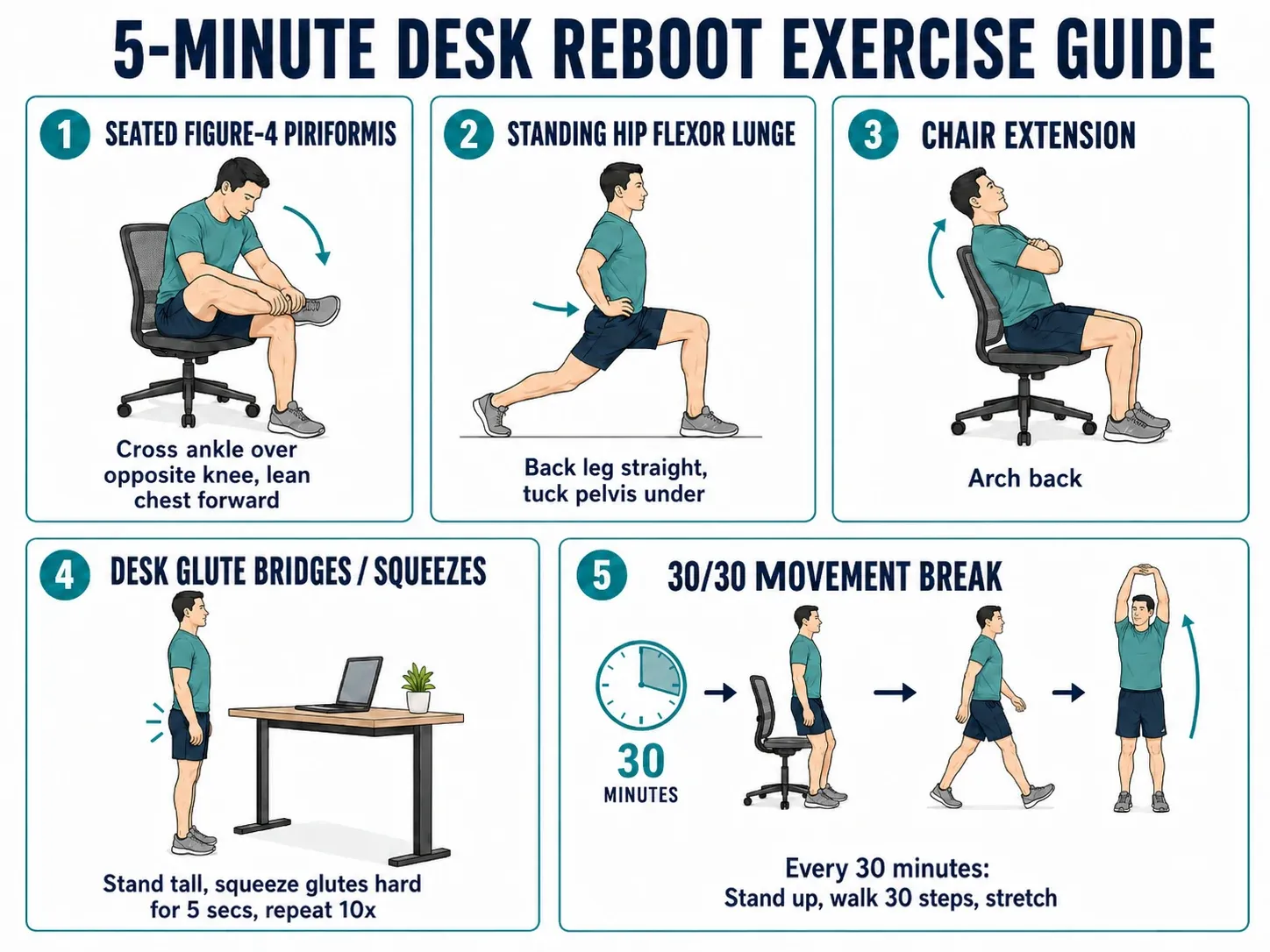
You do not need to leave your desk or change into gym gear to counteract the mechanical strain of prolonged sitting. Performing these 5 targeted exercises during the day will reset your pelvis, activate dormant muscles, and decompress your spine:67

1. Seated Figure-4 Piriformis & Glute Stretch
- Target: Releases deep hip rotators and decompresses the sciatic nerve pathway.
- How to do it: Sit tall near the edge of your chair. Cross your right ankle over your left knee, creating a “figure-4” shape. Keep your spine straight, take a deep breath in, and gently hinge forward from your hips until you feel a deep, comfortable stretch in your right outer hip and buttock.
- Dose: Hold for 20–30 seconds. Repeat on the left side. Perform twice daily.
2. Standing Desk Hip Flexor Lunge
- Target: Opens the tight psoas and iliacus muscles after hours of hip flexion.
- How to do it: Stand beside your desk. Step your left foot forward and your right foot back into a shallow lunge. Tuck your pelvis slightly under (posterior pelvic tilt) and gently squeeze your right glute. Shift your weight forward slightly until you feel a firm stretch across the front of your right hip.
- Dose: Hold for 25 seconds while breathing slowly. Switch legs.
3. Seated Thoracic Extension over Backrest
- Target: Reverses the slouched upper back posture and opens the ribcage.
- How to do it: Sit back in your chair so the top of the backrest sits just below your shoulder blades. Place your hands behind your head to support your neck. Inhale deeply and gently arch your upper back backward over the backrest, looking up toward the ceiling.
- Dose: Hold for 3–5 seconds at the end range. Repeat 5 to 8 times.
4. Standing Isometric Glute Squeezes
- Target: Re-awakens dormant gluteal muscles after prolonged compression.
- How to do it: Stand upright with your feet hip-width apart. Squeeze both buttocks together as firmly as possible without arching your lower back.
- Dose: Hold each contraction for 5 seconds, then relax. Complete 10 repetitions during phone calls or waiting at the kettle.
5. The 30/30 Posture Reset Rule
- Target: Prevents static ligament creep and re-oxygenates spinal tissues.
- How to do it: Set a gentle timer on your smartwatch or calendar for every 30 minutes. When it triggers, stand up for 30 seconds: roll your shoulders backward 5 times, take a sip of water, and look 20 metres into the distance.
7 Everyday habits to cut sitting time for Chatswood workers
Transforming your sedentary habits does not require a complete overhaul of your job. Small, repeatable changes to your environment make movement happen automatically:
- Conduct “Walking Meetings”: When meeting with one or two colleagues, walk outside along Victoria Avenue or through Chatswood Park instead of booking a conference room.
- Stand During Phone Calls: Make it a non-negotiable rule that whenever your phone rings or you speak on a headset, you stand up.
- Move Your Water Bottle: Keep a smaller water glass at your desk so you naturally stand up to refill it at the kitchen every hour.
- Optimise Your Commute: If taking the Sydney Metro or train into Chatswood Station, stand for the first 3 or 4 stops before taking a seat, or walk from an earlier stop.
- Separate Lunch from Your Desk: Never eat lunch while staring at your computer screen. Walk to a nearby café or park bench to give your eyes and spine a complete break.
- Use a Sit-Stand Desk Correctly: If you have an electric height-adjustable desk, aim for a 2:1 ratio (sit for 45 minutes, stand for 15–20 minutes). Avoid standing motionless for hours, which can cause foot and lower back fatigue.
- Audit Your Evening Screen Habits: After 8 hours at a work desk, avoid transitioning directly to 4 hours on the sofa. Break up TV viewing with light stretching or foam rolling on the floor.
When prolonged sitting discomfort requires professional care
While ergonomic tweaks and movement breaks provide relief for general tightness, recurring or chronic pain often points to underlying spinal joint restrictions, pelvic misalignment, or disc issues that need clinical assessment.
How Body Therapy Chiropractic in Chatswood can help
At Body Therapy Chiropractic, located in the heart of Chatswood on Help Street, our practitioners specialize in diagnosing and managing work-related musculoskeletal conditions:
- Comprehensive Postural & Biomechanical Assessment: We examine your pelvic alignment, lumbar lordosis, thoracic mobility, and forward head carriage to identify specific mechanical imbalances.
- Joint Mobilisation & Gentle Chiropractic Adjustments: We restore normal movement to restricted spinal joints (lumbar, thoracic, and cervical) to reduce nerve irritation and relieve stiffness.
- Myofascial Trigger Point & Soft Tissue Therapy: We release tight hip flexors (psoas), piriformis, and upper shoulder muscles while activating dormant core and glute stabilizers.
- Personalised Ergonomic & Rehabilitation Guidance: We provide tailored exercises and practical workstation advice that matches your exact office setup.
Our team, led by James Zheng (consulting in English and Mandarin) and Gianna Lau (consulting in English and Cantonese), provides evidence-informed, transparent care with on-the-spot HICAPS private health fund claims.
Explore our condition guides on Lower Back Pain, Neck Pain, Posture Correction, and Hip Pain, learn about our consultation process on our What to Expect page, or check our Pricing and Health Funds information.
Frequently asked questions about prolonged sitting
Why does my lower back ache after sitting for only 20 to 30 minutes?
When you sit, your pelvis tilts posteriorly, flattening your lower back curve and increasing pressure on the L4–S1 lumbar discs. If you already have tight hip flexors, weak core muscles, or mild disc sensitivity, this sustained pressure rapidly irritates spinal ligaments and nerves, causing an aching sensation.
Can tight hip flexors from sitting cause knee and hip pain?
Yes. Chronically tight hip flexor muscles (psoas and rectus femoris) pull on the pelvis and alter the tracking of the kneecap (patellofemoral joint). They also restrict hip extension during walking, forcing the knee and lower back to absorb abnormal rotational forces.
Is standing all day at a standing desk better than sitting?
No. Static standing for 8 hours causes its own set of problems, including blood pooling in the lower legs, varicose veins, plantar fascia strain, and facet joint compression in the lower back. The healthiest approach is dynamic variation—alternating between supported sitting and standing throughout the day.
What is “glute amnesia” and how do I know if I have it?
“Glute amnesia” occurs when prolonged sitting inhibits the neural pathways connecting your brain to your gluteal muscles. Common signs include a flat buttock appearance, tight hamstrings, lower back soreness when walking uphill or climbing stairs, and difficulty squeezing your glutes intentionally while standing.
When should back pain from sitting be reviewed by a doctor or chiropractor?
Seek professional review if your back pain persists for more than 2 to 3 weeks, worsens progressively, radiates down your leg as sharp pain or tingling (sciatica), or disrupts your sleep. Call 000 immediately if back pain is accompanied by loss of bladder or bowel control, progressive leg weakness, numbness in the groin, or high fever.4
What this article cannot determine
This article provides general ergonomic and lifestyle advice and cannot diagnose individual spinal injuries or disease. It does not replace a clinical examination, diagnostic imaging (X-ray, CT, or MRI), or personalized medical treatment.
If you suffer from sharp, radiating, or worsening back pain, consult a registered healthcare practitioner for an accurate diagnosis.
Take control of your workday health
You do not have to accept persistent back ache, tight hips, and mid-afternoon fatigue as an inevitable consequence of desk work. By breaking up your sitting time, stretching tight hip flexors, and seeking professional care when needed, you can maintain a resilient, pain-free spine.
- Read our complete guide: Back, Neck and Posture Concerns: A Practical Chatswood Guide.
- Check your workstation: Tech Neck and Screen Habits: A Practical Desk Setup Checklist.
- Book an appointment: Visit Body Therapy Chiropractic online or call our clinic at Level 2, Suite 204, 6 Help Street, Chatswood NSW 2067.
References
Footnotes
-
Nachemson AL. Disc pressure measurements. Spine. 1981;6(1):93-97. ↩ ↩2 ↩3
-
SafeWork NSW. Sedentary work and ergonomics: Practical risk management guide. NSW Government. Accessed August 2026. ↩ ↩2 ↩3
-
McGill SM. Low Back Disorders: Evidence-Based Prevention and Rehabilitation. 3rd ed. Champaign: Human Kinetics; 2015. ↩ ↩2 ↩3
-
Healthdirect Australia. Back pain causes, red flags and management. Australian Department of Health and Aged Care. Accessed August 2026. ↩ ↩2
-
Wilke HJ, Neef P, Caimi M, et al. New in vivo measurements of intradiscal pressure in various postures and during muscle exercises. Clinical Biomechanics. 1999;14(4):243-255. ↩ ↩2
-
Page P, Frank CC, Lardner R. Assessment and Treatment of Muscle Imbalance: The Janda Approach. Champaign: Human Kinetics; 2010. ↩ ↩2 ↩3
-
Safe Work Australia. Ergonomics and preventing musculoskeletal disorders at computer workstations. Australian Government. Accessed August 2026. ↩